The Art of Arrival (and a painted turtle)
Day One! Bright, cool, and breezy. 10:00 am.
I've gone to the pond many times to sit. Practice runs with my pack of supplies, learning what I need and don't need to haul along. This time I have a notebook, (and a pen!), binoculars, a sit pad, coffee, my trailcam, and my phone. There's no point in bringing my camera without a proper lens, and I grumblingly leave it behind.
The pond is close—a ten-minute bike ride at most, barely enough time to warm up. As I pull in under the trees the kingfisher that hangs out there gives me a scolding chatter and takes off towards the river. I make a mental note to approach the pond more politely in the future.
I still haven't found a favorite sit-spot, so I try a new one close to the water: a little flat patch of dirt behind a tree trunk, half-chewed by beavers, and a big rock. It's just flat enough for my butt and my pack. While it doesn't offer a full view of the pond, it does get me closest to the water. Accepting that I'm just going to be disruptive for a little bit, I rustle around unpacking, apologizing quietly to the conspicuous silence, and finally settle in with my coffee.
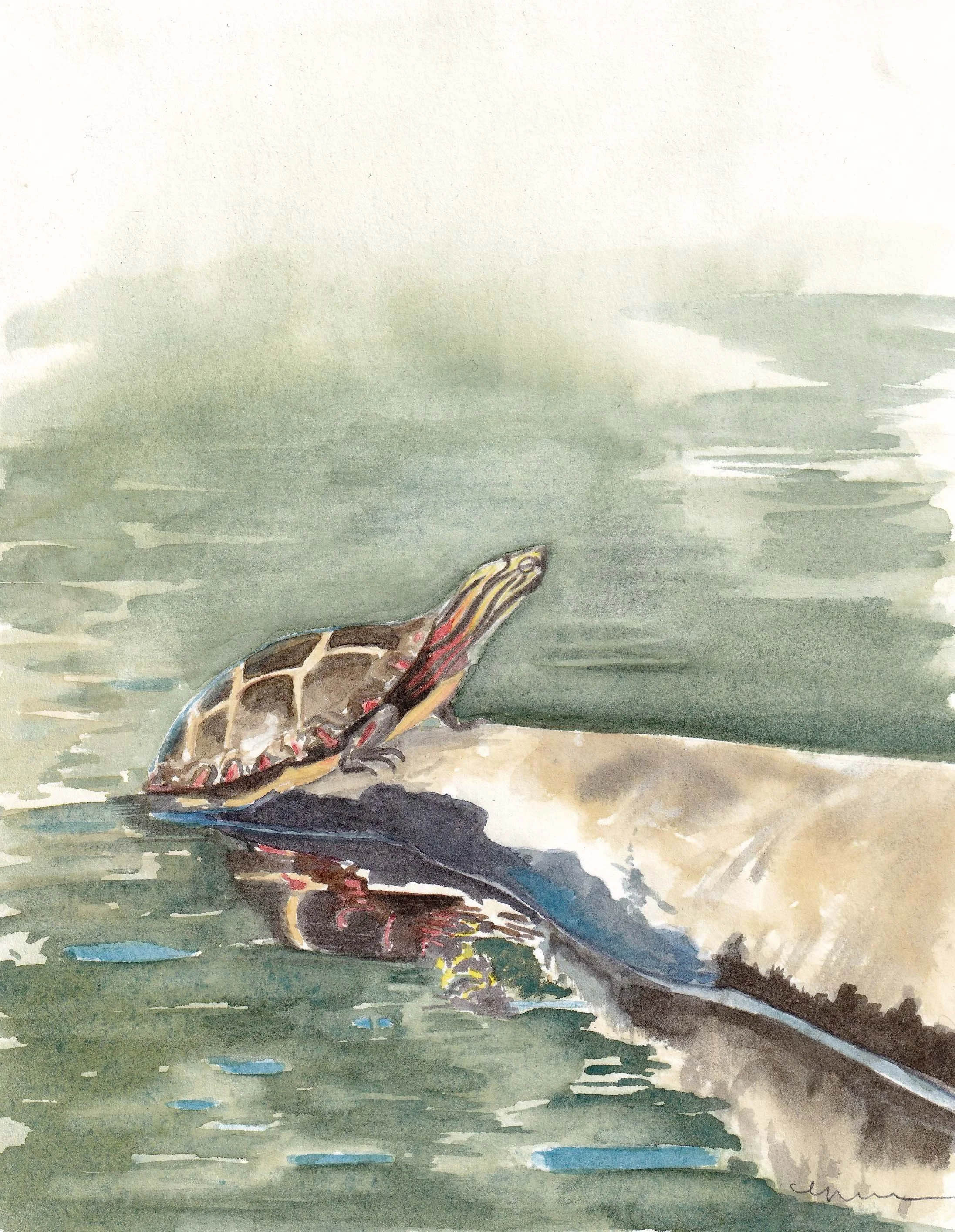
Not two minutes after I quiet down, there's movement to my right and I turn to see a small, lone painted turtle on a felled log poking out of the water. It immediately plops back into the water. I'll turn more slowly next time.
It doesn't take long for the pond activity to resume. Two song sparrows hop and pick around in the weeds to my left, close enough to watch clearly without my binoculars. The water is clear enough to get a good look at how shallow it is all the way across. I wonder just how thick the layer of muck and leaves is. Red-winged blackbirds' clattering songs fill up the air– "clack, honk, squee, brrrrrrrrrrrrrrr!!!" I try to get a good look at them, but they're mostly hidden in cattails behind more cattails; I can hear them better than I can see them.
I focus on the water near my feet with my binoculars and notice movement in a pile of debris. I wait patiently for something to emerge and realize the debris is the movement– a caddis-fly larva! Sticks, bits of leaves, and something long trailing behind move slowly along. A red-spotted newt also notices and floats stealthily nearby, watching the mysterious little pile. I hold my breath, but the larva goes still and the newt moves on. Next time.
Now there are newts all over the place! Some have lumpy bumpy bodies, and a moment of worry, I recognize the masses as eggs. Later I learned that females lay 200-375 eggs, one at a time, on carefully selected leaves under the water.
The turtle is back. I turn slowly and carefully this time. It's small–maybe the size of my two hands. How big do painted turtles get? Is it weird that there's only one? Usually I see loads of them sunbathing in ponds, though I've never seen many here. Lovely bright red stripes, fading to yellow, run along its neck. It sits with its shell to the sun and stretches its head out. Either I'm doing a very good job being quiet, or it's decided that the sun is worth it and has grown less wary of me.
At home, I look up painted turtles. They spend the winter nestled in the muck at the bottom of ponds where it's dark, cold, and low in oxygen. They're among the first reptiles to emerge, and when spring comes, sunbathing is a top priority. Sometimes they pile up 4-5 turtles high as they compete for the best basking spots! This pond has no such population challenges, and this little turtle has the log all to itself.
I’d like a good photo of it, but the only way I can zoom in is by awkwardly lining my phone camera up with my binoculars. It leaves much to be desired, but it's what I've got to work with for now, and I think I've got a good enough shot to draw from.
After an hour, my body is stiff, my coffee is cold, and the kingfisher still hasn't come back. I stand up; the turtle slips quietly back into the water, and I head back to my bike. I'm ready to go home and paint, but the old beaver dam beckons with its low springy vegetation, making it unusually passable. I venture out and peer at the muddy spot on the top of the dam, where a creek flows through to the other side. I’m hoping to see signs of otters, but it’s just a well-traveled muddy path—otherwise uneventful. I gaze out along the dam, debating whether to explore further, then decide I've already pushed my luck enough. Dry feet are pretty nice to have. I turn around. I still need to set up my trail cam on the other side of the pond.
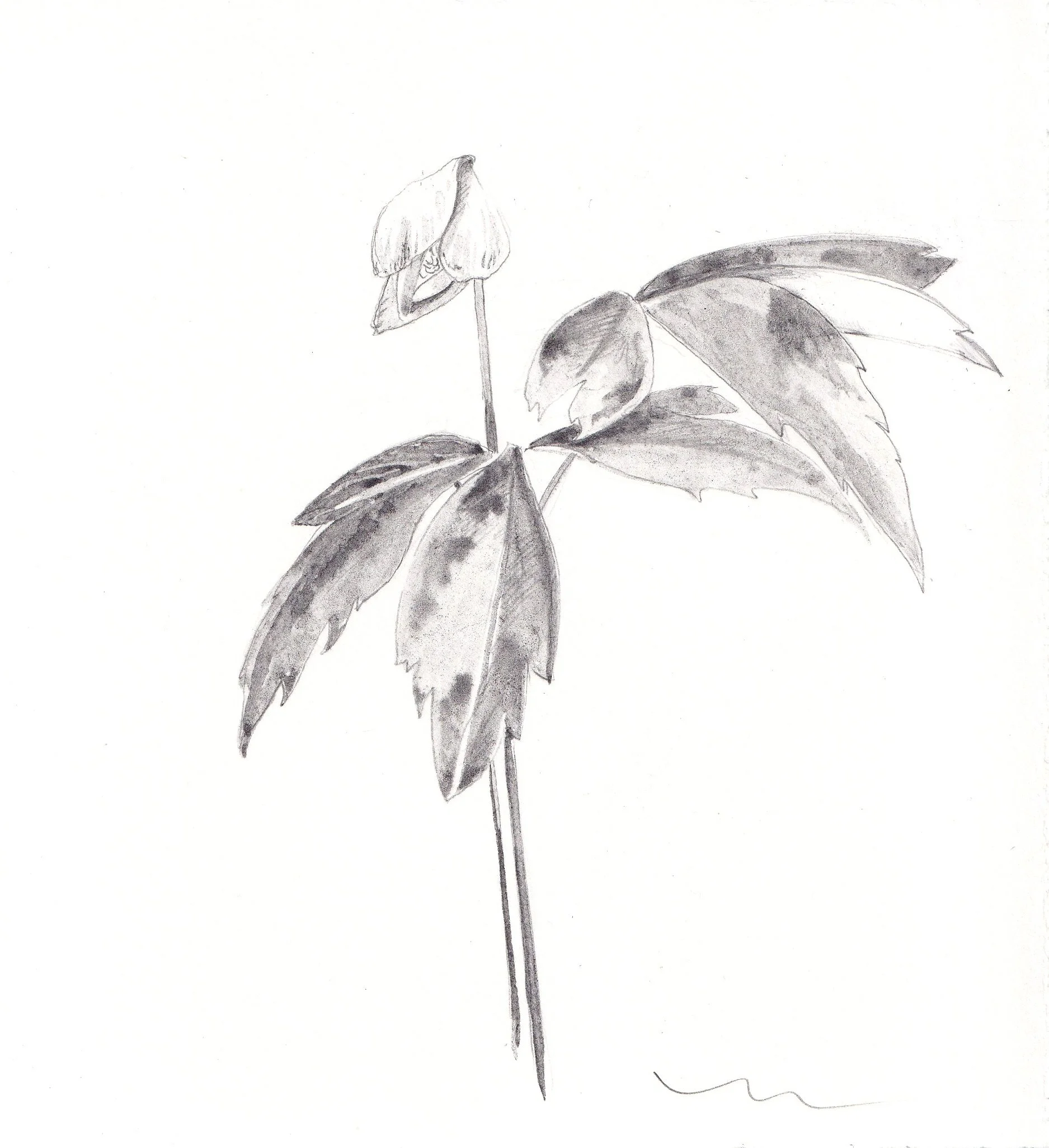
I ride across the beautiful bridge Jack built and park on the other side of the creek that feeds the pond. As I walk towards the spot where I want to set up my camera, I notice patches of wildflowers that I don't recognize: long stems, deeply divided and whorled leaves, white flowers. The blooms are still shut against the cold morning air, and I can't get a good look. I pause, puzzled that there is a flower in these woods I don't know. Probably I've just forgotten – when they open I'll know exactly who they are.
I set the camera up, pointing it at what I hope is a trail leading across a log on the stream. So far, near this spot at the creek, I've captured the blurry black-and-white tail of a too-close skunk, the ass-end of a weasel, and the ghostly shape of a maybe-bobcat. Also hundreds of pictures of a dried sensitive fern spore frond twitching in the wind. Hopefully this setup is a better spot.
On my way back out I pause to investigate the flowers again. Nope. I do not believe I've met this friend before. I scan the patches, looking for an open flower– something to give me a better clue. No luck. I photograph what's there and head home, excited to look up all of the questions I have.