Loch Ness Muskrat
7:30 am. July 24th.
I've been walking the dogs in the morning before work, and while it's a little sketchy — being in the woods when the critters are active — it also means I get to see some critters. Always, as we turn toward the pond, I call the dogs into a heel by my side, so they're less likely to disrupt things. One morning I see big ripples in the water and someone small, brown, and furry swimming toward the bank, where it dives down and disappears. An otter! An otter?.......maybe?
Another morning we crest the little hill on the trail and something in me makes me grab the dogs' collars. I peer around, unsure of what has the hairs on my arms standing up, and then I see a solid black shape through the trees. Bear! Somehow it doesn't see me, and somehow the dogs don't see it. After a few (very unwise) attempts to get the bear to carry on its way by whistling at it, I realize my dumb luck that nobody has noticed anyone else, and I turn around and we head back the way we came.
Early is a good time to be at the pond.
On Wednesday night, lying in bed reading my sci-fi novel, miraculously not thinking about work, it occurred to me that the next morning would be a good one to go to the pond without the dogs, early, to sit and watch before I have to be at my desk.
"I should get up now and pack my bag." "But it's cozy here, and these folks are just about to find all the water on Mars…" "..." "Fine."
I'm grateful to my past self at 6:00am, when all I have to do is make coffee and head out the door. But as I head up the trail — I've decided to hike, not bike — I feel less grateful. What the hell did I think I needed all this for last night? Camera, lenses, binoculars, notebook, my biggest mushroom book, a little digital microscope, water, coffee, snacks. This backpack weighs so much! This damn hill is so steep!
Then the breeze hits me at the ridge, and I forget about the weight.
I see a deer, a bumblebee in some ghost-pipe flowers, a couple of lovely mushrooms (though fewer than I expected after yesterday's rain). Pinesap flowers come up out of the leaf litter like funky, pale, upright-rooted pinecones. The rising sun hits a mossy rock wall and it becomes a tiny Irish meadow.
In the sedge clearing I hear a Red-eyed Vireo way up high, and the sweet, slightly spooky song of a Wood Thrush cuts through the air. In the pines a Red-tailed Hawk has a lot to say, and an Eastern Wood-Pewee's call comes from seemingly every direction.
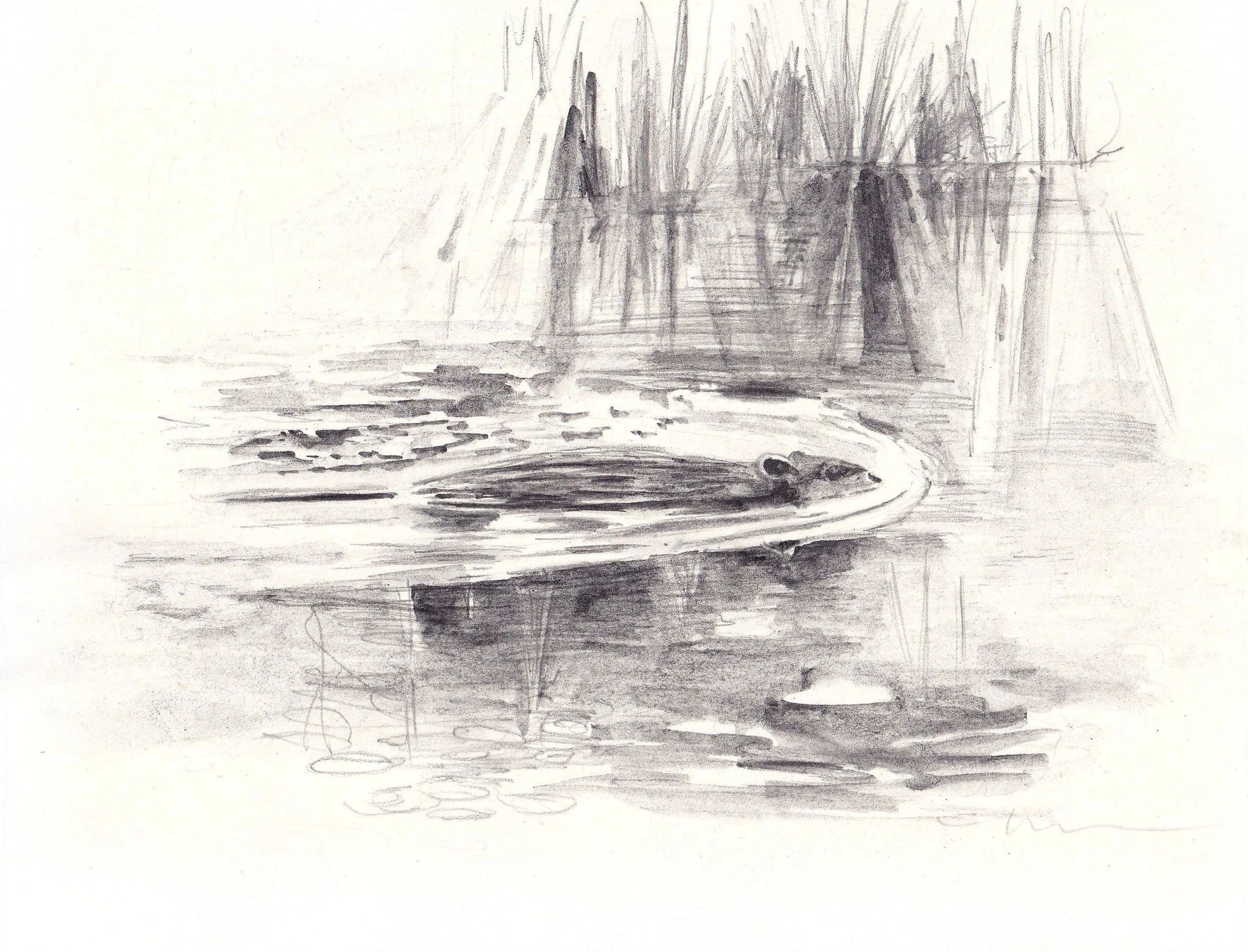
The pond is still fully in shadow, and the small, brown, furry someone is there and swimming when I arrive. It's not expecting me in the least, and it practically swims right up to me and along the bank at my feet. I can see its white chin, its funny little ears, its skinny, furless tail trailing behind. It's not an otter — it's a muskrat! I've never seen a muskrat before. I don't know the first thing about them.
And so, of course, I read up on them the moment I'm home.
——
Muskrats have quite a bit in common with beavers — they build lodges (though out of aquatic vegetation and mud instead of limbs and mud), they have dense, soft, waterproof underfur and long, glossy guard hairs, and both beavers and muskrats have specialized teeth that let them chew underwater without taking in water. Muskrats are primarily herbivores, though they'll eat crawfish, clams, mussels, snails, fish, and sometimes young birds.
Muskrats build all kinds of structures. They build bank burrows, with underwater entrances, which can run up to forty-five feet inland(!) and lead to dry living quarters not much larger than the tunnel itself. The end cavity includes an airshaft, topped with sticks and grass above ground. In winter they build "push-ups," where they break through thin ice and pile up fine roots, vegetation, and other debris. As the pile grows it forms a little hut on top of the ice — a breathing station where muskrats can rest away from their den while staying concealed from predators. They also build feeder platforms — roofed structures where they can eat, warm up, and catch their breath out of the elements — and canals. So much to look for!
——
I watch it swim a few big meandering laps around the pond, then duck under at the dam and disappear into the bank — must be its burrow.
Mist blows across the surface of the water, a woodpecker thrums, a green frog thunks.
The muskrat comes back out, and the click of my camera shutter startles it — it dives back under, heading toward the east end of the pond.
Shortly after, there's a commotion in the middle of the pond — splashing, bubbles, big ripples — something happening underwater that I can't see. Maybe the snapping turtle decided to get wildly energetic and go after a fish while swimming? That seems unlikely. Did the muskrat run into trouble? What would make such a ruckus? Must be the pond's own Loch Ness monster. The hubbub dies down. The mystery remains.
The sun slowly makes its way across the pond, and the turtles and frogs start to stir and poke their heads out of the water. I see the snapping turtle — its shell nearly a foot long — and for the first time I can actually make out its facial features, craggy and sharp.
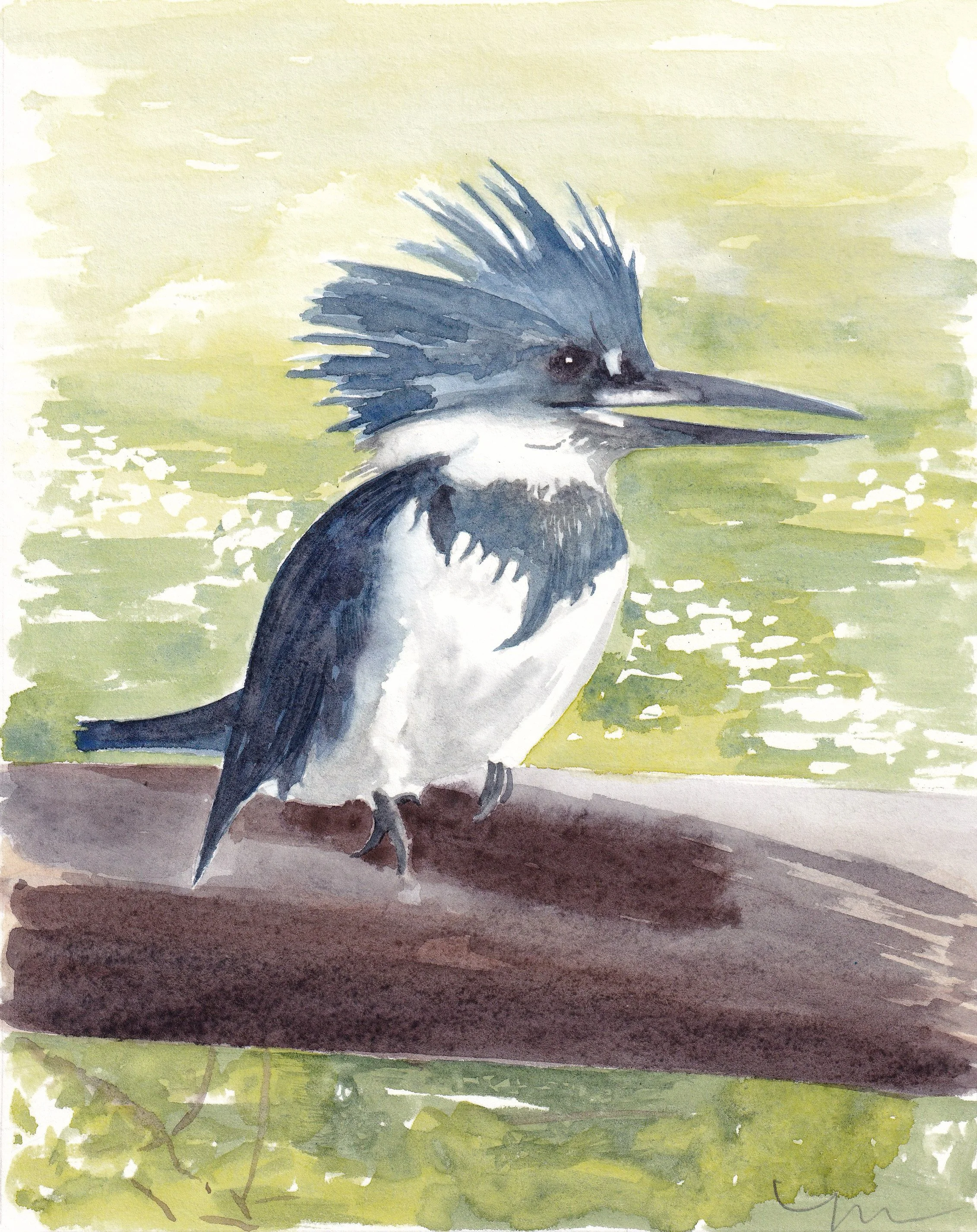
A Belted Kingfisher comes hollering in, loops around the pond, and — much to my delight — lands on a tree to my left. Close enough to watch without my binoculars: its belly all white (a male), its shaggy crest standing straight up as it continues its rattling call. They prefer small, clean bodies of water, and I've startled them here before, but this is the first time I've gotten to actually watch one. He chatters on for about thirty seconds, then takes off toward the river.
The pond quietly ripples and bubbles. I sip my coffee, enjoy the quiet, the shining reflection of a heron in the sky's bright sun passes over the shady dark water, a catbird mews, a breeze rustles the cattails. Every now and then a Red-winged Blackbird calls, but nothing like earlier in the summer — does the cacophony die down once the nests fledge? When do they migrate?
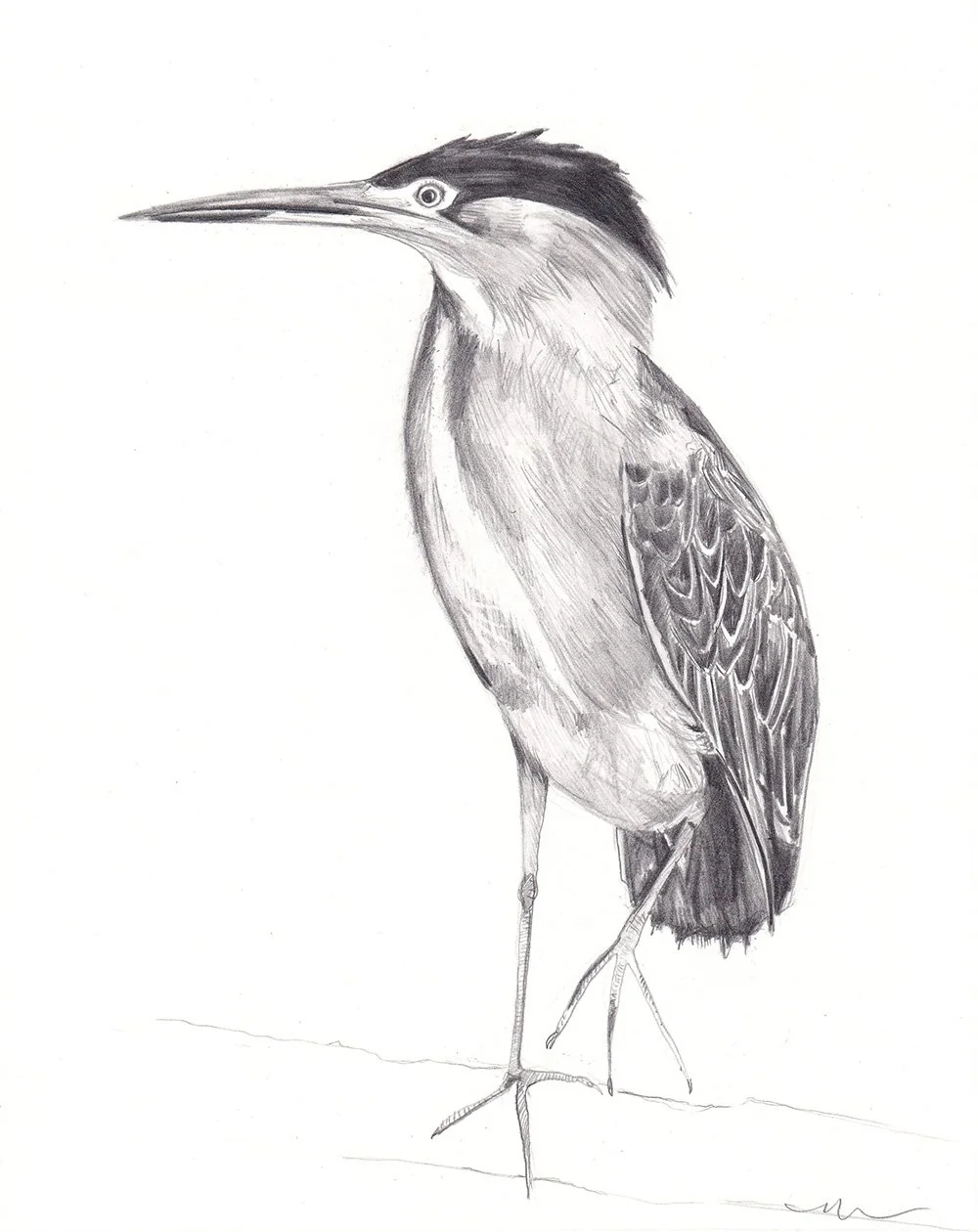
A Green Heron lands in a tree to my right. This is a morning of birds with impressive crests! It's small and dark, with a golden eye and a rich brown neck marked by a white line running from its chin down its chest. It perches there, on skinny yellow legs, just long enough for me to note its characteristics then away it goes.
A frog floats in the sunny water, two bulbous eyes poking just above the surface, casting a wacky reflection. The cicadas' song is picking up as the sun warms the grass, and it's time for me to go to work. I head toward the creek, and as I pass the marshy part of the pond, there's the muskrat again! Busily working on the vegetation in the marsh. This time I managed to line up my camera and catch it swimming past.
Come back before dawn to watch the pond wake up — everything is alive in this crepuscular moment.