Still Frogs, Still Herons
June 8th, 4:30pm.
Breezy, dry, in the low 80s. Buy a thermometer.
Finally back. Three weeks is too long—on top of the zinnias, poppies, peonies, and dahlias requiring all of my time to get settled in their garden home, there was the hurdle of wanting to come at dusk (my brain turns into a sloppy blob at 3pm everyday), and a small heartbreak to contend with.
At some point, during the three weeks, I learned that the corn fields bordering the pond are, in fact, sprayed with glyphosate. I spent an entire evening unable to really speak. I knew this was the case, but had yet to see it happen, or to have spent hours with the fish, newts, turtles, bugs, and plants to be affected by it. I attempted to research how glyphosate affects wetlands, but after wading through confusing scientific abstracts, contradictory reports, and unclear articles, I came away with the impression that the impacts of these herbicides on wetlands are still not well understood. Though, everyone seems to agree that they do impact them, whether directly or indirectly. Either way, I would love to observe what happens to this pond when/if these corn fields are turned into hay fields (are hay fields treated with things?!) and there are rumors that that could happen soon.
Anyway, I'm here now. This time I walk in rather than bike in and I'm better able to notice the surrounding area, which I've taken for granted in my familiarity of walking the dogs here so often. I rarely approach the trail/bridge from this direction and it's beautiful coming from the sunny fields into the cool shade of the woods.
The water continues to be very low and I still haven't devised a method of telling how much lower. But, I know it hasn't rained enough; my flower garden has plenty to say about that. When I first met this pond it was not a pond at all, but a mucky wetland that had been a pond and had since gone through an entire drying cycle. I was able to approach the abandoned beaver lodge from the front and peer inside of it–which was full of porcupine scat. That was before the path, when accessing the pond meant working your way through tall thickets of grass. Then, the beavers returned and the water filled up again, and the path was built, and the beavers left again, and with them no longer maintaining the dam and the dry weather, here we are.
Today, the water is covered in pollen, just like our cars and our houses and our brains. The pond looks almost viscous with this thick yellow coating on top.
I’ve picked out a new sit spot–on top of a rock above the old beaver dam. I'm under the trees here, but not in the trees with my view obscured by branches. I've also noticed more turtle action on this end of the pond where it's shallower (maybe?). The air is dry and breezy and after a long day, I'm delighted to be here. The Red-winged blackbirds are quiet now and there's the lone call of a green frog across the water; a banjo-like "gunk."
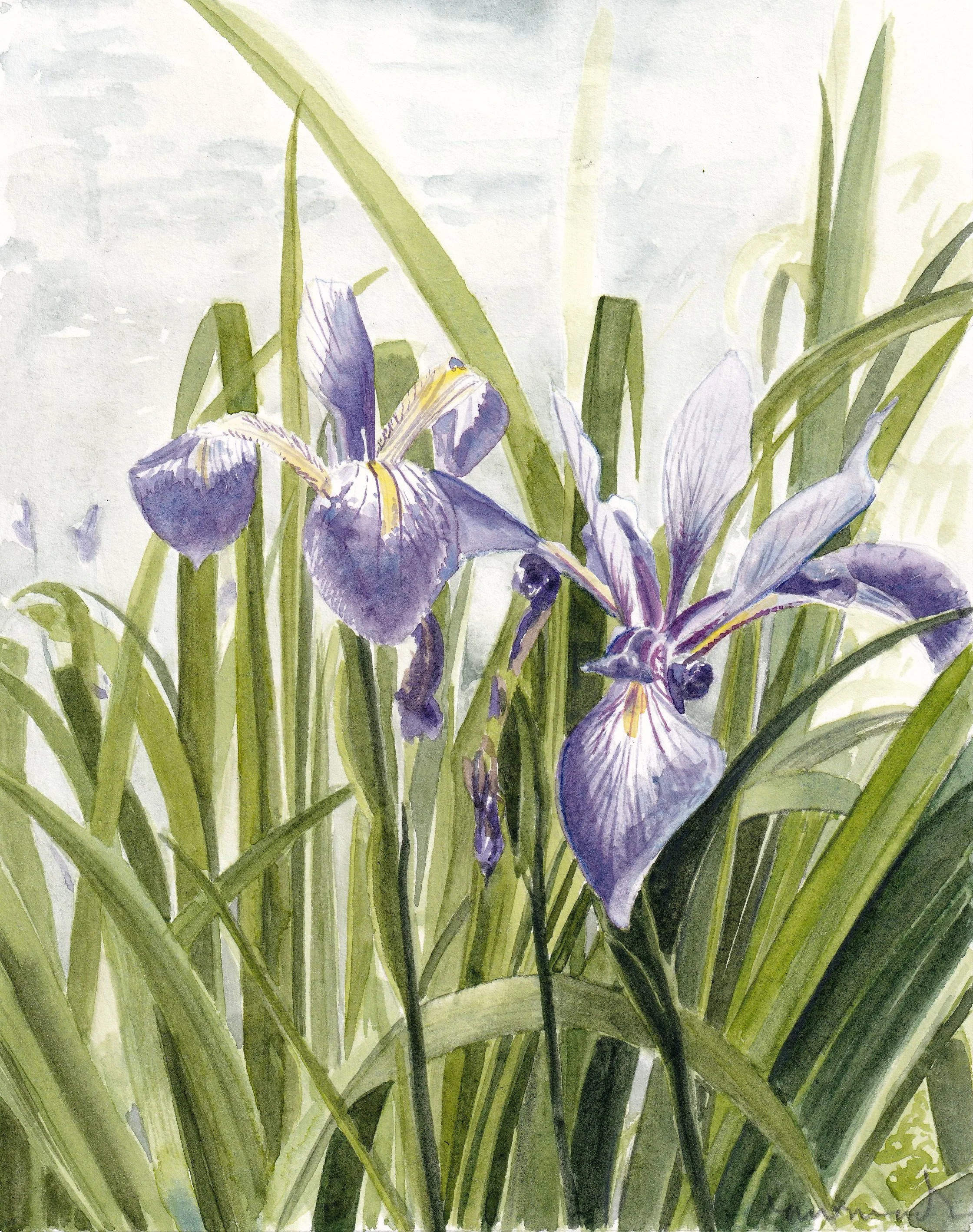
Iris versicolor
Two patches of Blue Flag Irises (Iris versicolor) are blooming on the bank below my perch and the Mountain-laurel (Kalmia latifolia) blanketing the northeastern edge of the pond will explode into a sea of white flowers any day now. I watch a yellow swallowtail butterfly visiting the few open buds.
There are tiny pairs of Partridgeberry (Mitchella repens) flower buds forming near my feet and an inconspicuous and rather uninspiring flowering vine thing to my right. Which, I think, is a very tiny Maple Leaf Viburnum (Viburnum acerifolium)--get a shrub book.
The water bubbles here and there, turtle heads pop up periodically, including that big stealthy knobbly one. A green frog sits on the bank in front of me, looking out towards the water. The tympanum (circular thing behind the eyes) is larger than the eyes, which helps me to identify the frog as a male. They breed late May-July and only the males sing. So what I hear thrumming across the pond is also a male. I watch a painted turtle slowly meander its way through the layers of vegetation floating just below the surface of the water. Is that how these winding pathways of clear space through the algae are being created?
A great blue heron flies in from behind me and I'm so surprised I gasp. I'm sure my gasp is so loud that the bird will just take right back off, but it either doesn't notice me or doesn't care that I'm here. It lands on the southern edge of the water, where it's open and grassy along the cattails, and begins its sneaky foraging. Ever so slowly, it lifts one foot and steps forward, placing it back into the water toes first with nary a ripple. It pauses, stares into the pond, then strikes its long beak into the water and comes up with a rather sizable fish! Not huge, by any means, but bigger than any fish I've seen on this side of the pond. For ten minutes I watch as it hunts its way along the edge until it meets the dam-end and flies away. Do they hunt mostly at dusk?
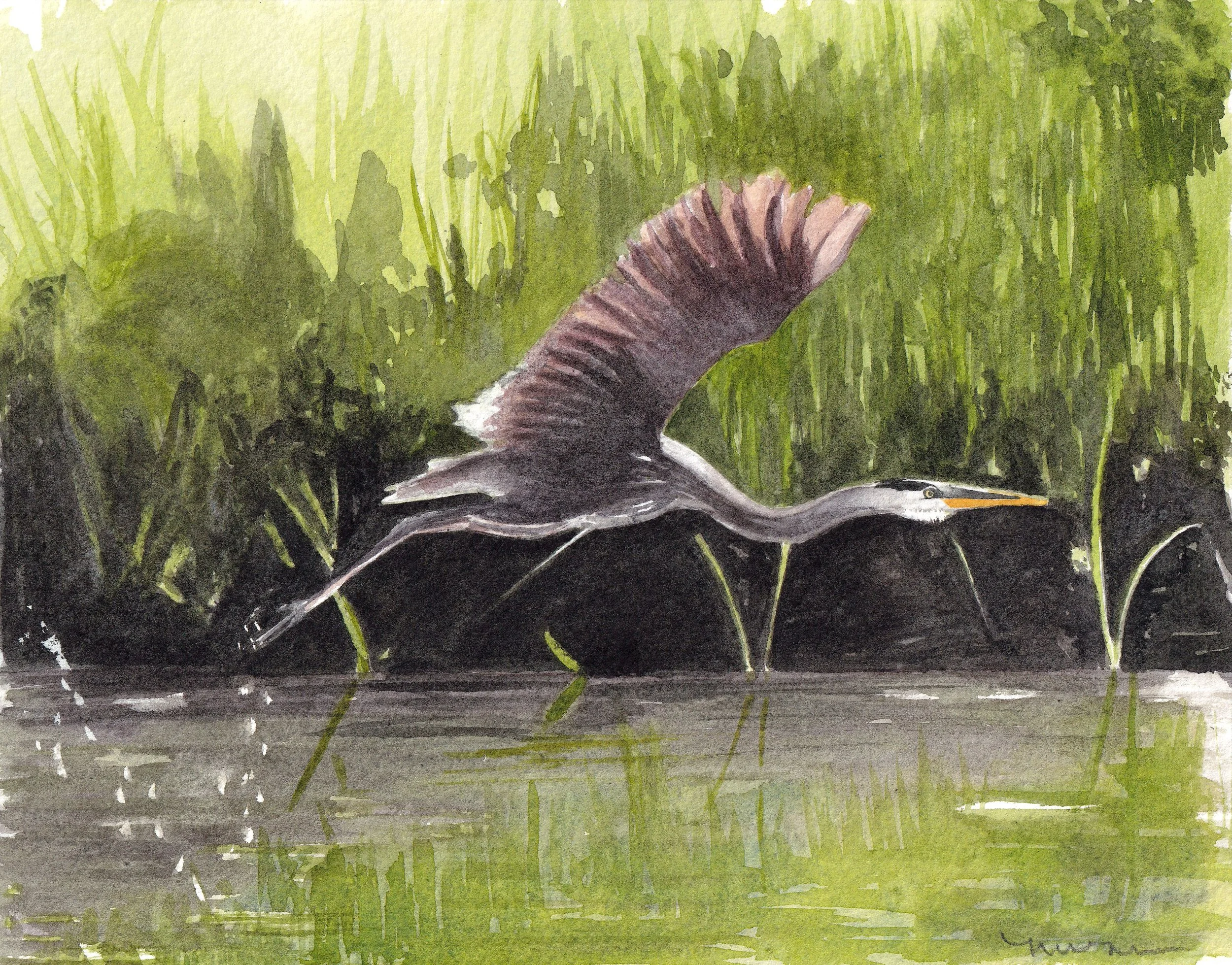
Heron Flight
The glyphosate they've been spraying on these fields for the past 30 years can't be ruining everything–there are still frogs with their thunking calls, turtles making winding roads in the algae, and fish for the herons.
I stare out at the pond. It feels lazy in the late afternoon slanting sunlight, different from in the morning when it feels like perched energy waiting to burst forth with the warmth of the sun. I want to know what it's like to be on the water, as ridiculous as it would look to have a boat on this puddle…procure a kayak.
I pack up and pick my way down the bank to take pictures of the irises and mountain laurel. The light hits the water just so and here in the shade I can see through to the bottom. There are lots of little fish. I wonder what the newts are up to…and the macroinvertebrates…procure a net.
There's a pile of scat in the wooded space between the path and the pond that looks to be entirely crayfish shells. There are even a few whole legs. Otter! There's a little path on a mound heading towards me from the dam. I set up my camera near here–not ideal–there's so much vegetation. I will have hundreds of pictures of the wind. Later I read about otter "rolls" and this seems like an ideal spot–where two bodies of water meet (the pond and the stream back to the river) and usually within 20 feet of the water. When I come back I'll know other signs to look for: dead vegetation, scraped up earth, a bowl shaped depression.
Zee and the dogs appear from our trail. The dogs are delighted to find me here and the quiet, slow portion of my evening exploration is over as they make a ruckus bounding all over creation and barreling their way through the brush. I try never to let them go in the pond, so we head to the river where they can play in the water.
The river has been installing its own new curvy oxbow where the northern cornfields are and slowly (though sometimes alarmingly quickly) carving out fields in exchange for water and steep sandy banks. Swallows have excavated holes along the cliff of sand. I haven't confirmed what kind of swallows they are, they look too orange-rosy to be Cliff Swallows, though that would certainly make more sense than a Barn Swallow making this kind of nest. Cave Swallows would be unusual. Bank Swallows?
While the dogs race along in the river–swimming, splashing, chasing–Zee and I stare at the nest holes in the bank and lo-and-behold we spy three eggs in one of the dwellings! From where we stand I can get an okay photo, but I want a better one. I ditch my shoes, find an accessible spot along the bank, and climb down into the water.
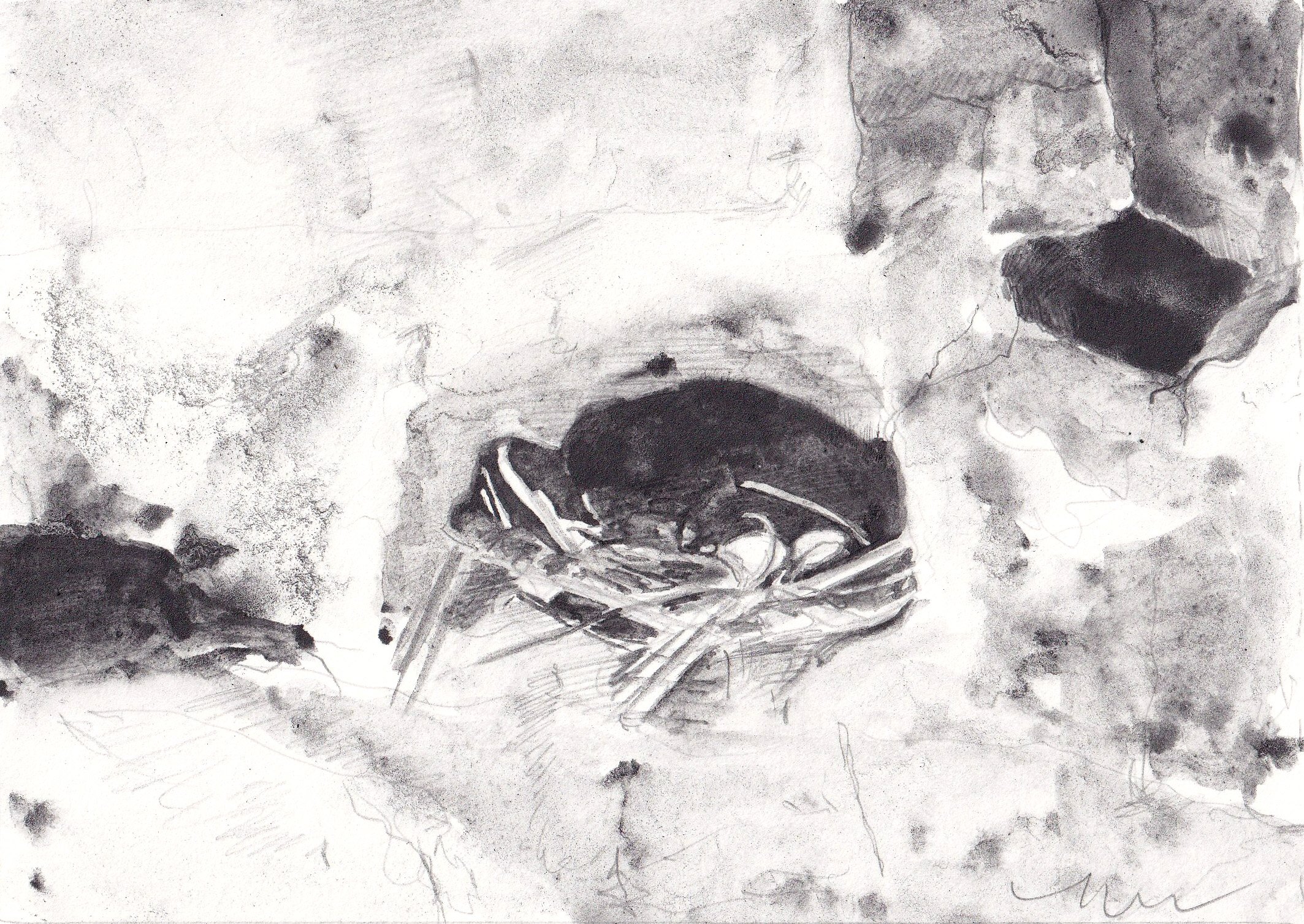
Bank Eggs
The rocks are hard on my bare feet. The dogs are delighted that I've joined them in the water. The water is cold, but not too cold. As I cross into the spot where the bank continues to erode and the swallows have nested, my feet sink into the silt and I do not like it. I freeze and consider turning around. Ugh, I'll just have to step in more to turn around and I'm so close. I grit my teeth and keep going, the sand and silt is thick and my feet sink up to my ankles. I get to the front of the nest cavity and quickly snap a picture. Not quite right. Cringing, I step over just a little more, position my camera just so, and press the shutter button. A red battery symbol flashes on the screen before the whole thing dies.
"DAMMIT!"
I don't have my phone down here and I certainly didn't bring another battery along because of course I didn't.
Zee shakes his head and chuckles at me.
I scoot as fast as I can back over the silt, stepping wide to try to avoid as much of the sinking sensation before I'm back on the rocks. I misstep and end up soaked to my hips. Fine.
I amble back in bare feet on the road made by tractor tires and dog walks until my feet are dry and the sand can be brushed off and my boots put back on. I say good night to the pond as we pass back by on the way home.