Maybe a Kestrel
May 17th, 6:45 am.
Cool morning. The air is still and already has the flavor of summer.
As I bike into the field that leads to the river and then to the pond, I notice a bigger body of water through the trees along the southern edge of the oxbow. I slam on my brakes and hop off my bike. I'd seen the reflection of this spot from the highest bit by the pond and have already casually tried to find it once before but without much conviction or luck.
Has this always been here? It would make sense as the water has no outlet back to the river on this end. Are the beavers here now? I see no evidence. No freshly downed trees, no dam, no lodge. A few years ago there was evidence along the river near here, including a low clump of sticks and branches with a path leading right through it like a perfect Tolkien-esque doorway. I've never explored back there–the promise of ticks and muck and possibly coming face-to-face with a beaver has always been thoroughly dissuading.
Not being able to see much from where I stand and unwilling to climb down into the utterly swampy thicket, I get back on my bike and head on to the pond. I'll keep an eye on this spot.
I arrive at the pond, a single duck takes off from the water and disappears over the horizon. I sit in the same spot as before, unpack, and settle down.
The water in the pond looks very low, but I don't have a good way to measure–even eyeball–the change over time. I've been thinking about this. Do I wade out with a stick? Draw a picture of the turtle log every visit? Just take a picture of the dam and compare water levels there?
The glass-still water, coated in a layer of pollen, is so quiet. The sun is still behind the trees and the birds are an absolute chorus of calls. There are red-winged blackbirds (of course), and Merlin (the birding app) tells me there's a rose-breasted grosbeak nearby. My lack of bird knowledge feels overwhelming. I stare at the growing list of birds the app identifies in the chaos, feel a little hopeless, and shut the app without saving the recording. I know what the red-winged blackbirds sound like and I'll stick to them for the moment.
There's a knobbly stick poking out of the water ahead of me and I think how weird it is that I hadn't noticed it before–then it silently disappears back into the water.
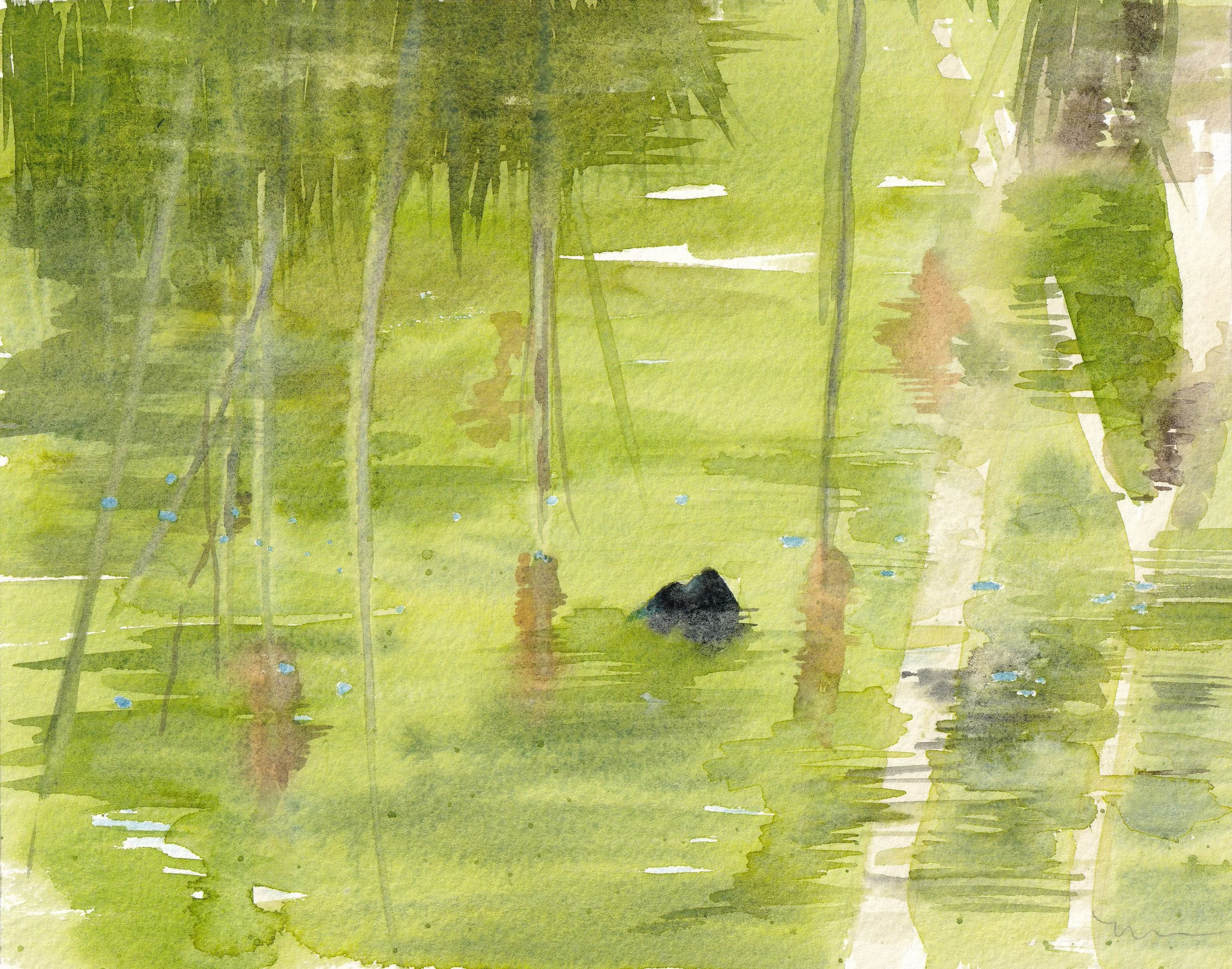
"There you are!"
I'd seen a snapping turtle as I walked by the pond with the dogs about a week ago. Now, as hard as I try, even with my binoculars I can't get a good look at it. It moves further from me and pops its head up closer to the dam. Then, silently back down (with hardly a ripple!) Up again, about five feet further out, its chunky face stealthily sits above the water, but all I can see is a shape. I can't even make out the eyes or nose. Every now and then the ridge of its carapace crests above the water. It's not gigantic, but it's also not small.
The surface of the water is so still that I'm watching the reflections of the swallows swooping back and forth. A somewhat disorienting view of green, sticks, sky, and pointed wings. A lady walks a black and white dog in the distance, calling out to it approximately every 30 seconds. The tree I'm sitting beneath–a beech–has begun to get in the way of my view from this spot. The leaves have the classic banding of beech leaf disease, but when I follow the branches back to the trunk, I'm flummoxed because the bark looks nothing like the smooth grey (or bark roughened by the cankers of beech bark disease) that I usually associate with beeches. Instead, it's rough and consistently ridged. Maybe because it's so close to the water, it's very old and very cankered, but unusually small? Maybe I'm looking at the wrong trunk. Note: take a better look at this when I'm back again.
I think I see some kind of piper (?!). It's a sparrow. The turtle head in the pond appears and disappears. The sun slowly crests over the trees and meets the southwestern edge of the pond where the cattails have grown up to about half the height of their previous generation's dried stalks. It's so quiet. I despair a little and wonder if I'll have anything to report. I can't even see any newts under the water.
Suddenly, the red-winged blackbirds change their tune and all at once the air is full of an alarming siren-like, "Eewee! Eeweee! Eeweee!" Just as I process that something has drastically shifted in what felt like impenetrable calm, I see the reflection of a bird of prey being chased and dive-bombed by three red-winged blackbirds. I whip my head up just in time to catch the tail ends of everyone before they disappear over the treeline. The raptor is smaller than a red-tailed hawk, has a straight tail and sharp wings. So fast! Maybe a kestrel? There are nesting boxes for them nearby.
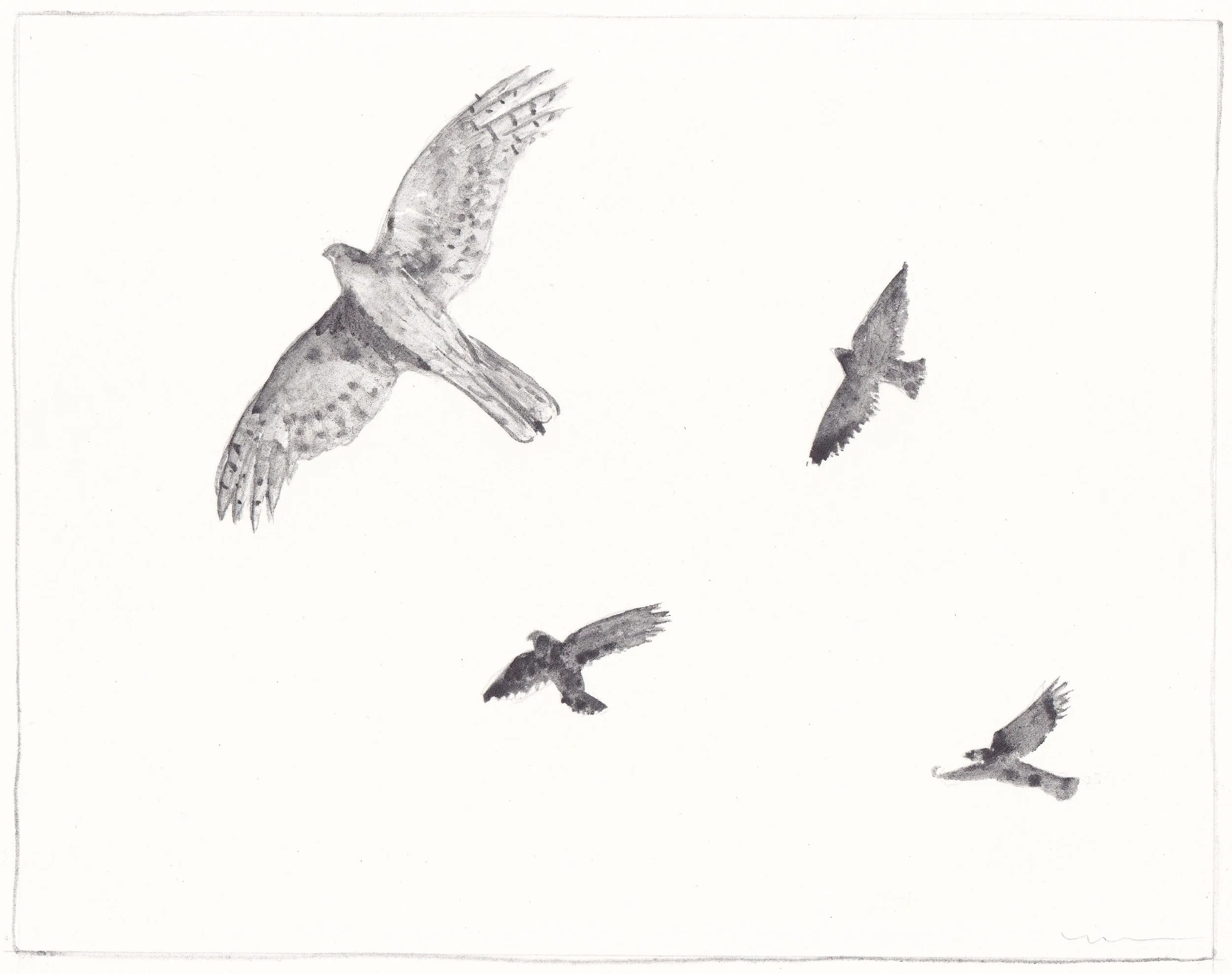
At home, I look it all up. Red-winged blackbirds are fiercely protective of their territory, especially during nesting season (now) and will "mob" larger threatening birds. Kestrels are quite small, about the size of a mourning dove, with a colorful head of slate-blues and rusty reds. I'm starting to think it was a sharp-shinned hawk. A lesson in being a naturalist: things happen fast. Patience and practice (and doing this) means someday I may be able to actually identify that bird in the amount of time it took for it to dart past.
The last action-packed five seconds feel like a good stopping point and my legs are falling asleep from sitting at a weird angle. Time to go. I stop on the way out to collect the trailcam and I drop my things by a tree – briefly considering that NOT bringing a camera over to the creek is probably a very silly idea. For just a second I think the trailcam is gone, but it's just so deep in new growth that I have trouble spotting it. There's an incredible patch of Foamflower, Tiarella cordifolia, and I kick myself for having no camera.
Still nothing too exciting on the trailcam. A derpy dog—the same I saw walking earlier—stares directly into the camera, the silhouette of a bird taking flight, and two deer in the marsh.
I make a folder on my computer called Trailcam: other people's dogs.
Next visit: scope out a new sit-spot. Come at dusk.